
Research areas
Why direct current, the three areas we work on, and how an idea goes from simulation to tested hardware.
Why direct current
Solar panels and batteries supply direct current. Electric vehicles, data centres and modern electronics run on it.
A grid built only for alternating current converts that power back and forth, and every conversion loses energy. We work on the DC grids that skip those steps.
Three research areas
The technology a DC grid needs to work at scale.
-
Power electronics
We design and analyse high-efficiency solid-state power converters: the routers that manage the power flows in a DC grid with minimal losses.
-
Grid stability
Renewable sources come and go. We research and implement control algorithms, such as droop control, that keep a DC grid stable.
-
Grid codes and protection
Equipment from different makers has to work together safely. We contribute to international grid codes, standards and fast fault protection.
From theory to reality
Every idea goes through the same three steps before we publish it.
Simulate and model
We simulate the topology and its control loops first, to prove the idea before any hardware is touched.
Build the converter
We design custom PCBs and assemble the converters, and solve real problems such as heat and parasitic inductance.
Test and validate
In the lab we test the converters under load and check the models against what we measure.
DC Domestic Appliances
The mobile DC kitchen is one of our projects with ATAG Benelux B.V. We built it in the project DC Domestic Appliances, supported by RVO and other company partners.
Students worked on DC appliances too: Hugo van Essen on several, among them a DC coffee machine.
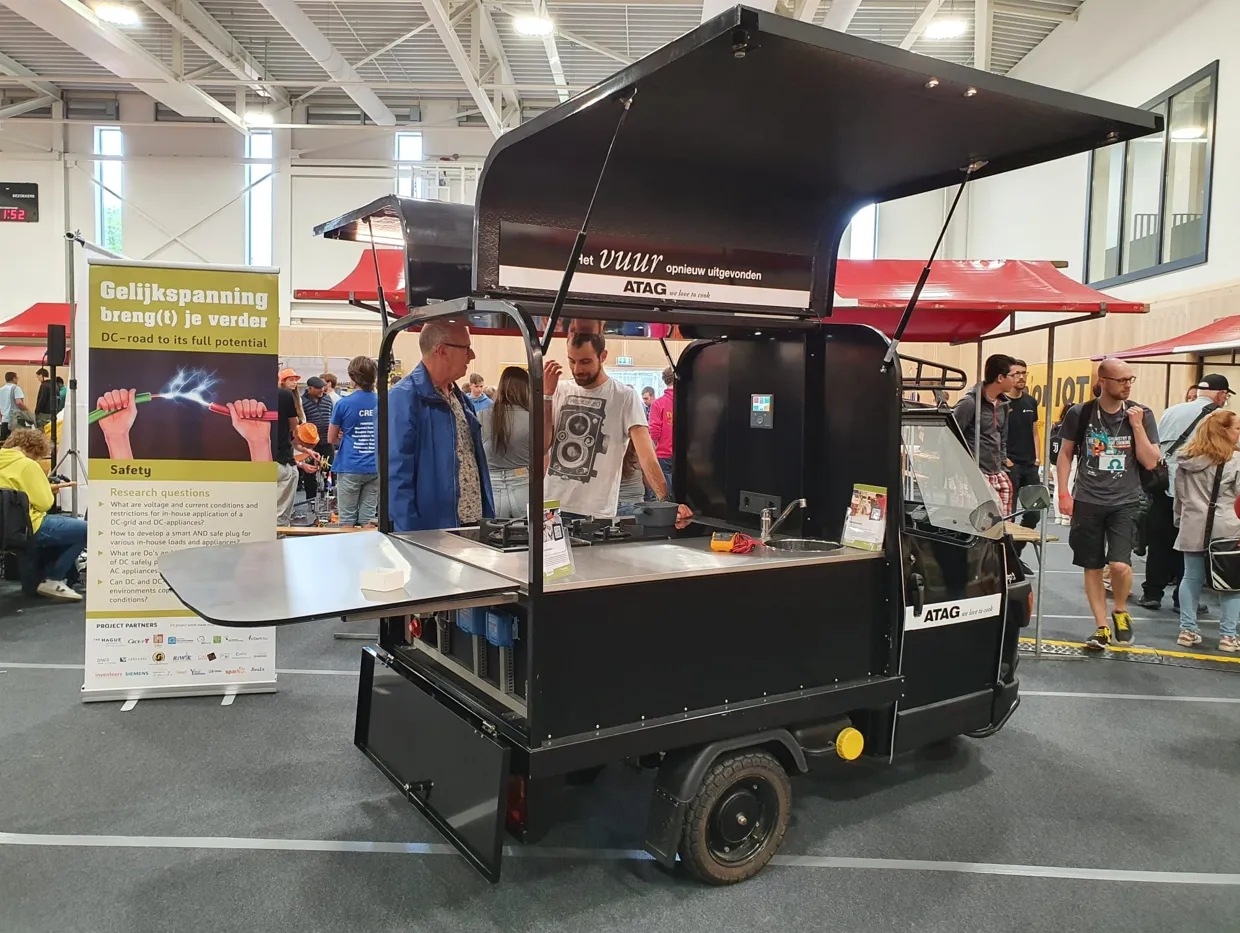
Photo needed: someone cooking on the ATAG DC kitchen1600 × 1200 · example photo shown


Photo needed: the DC coffee machine Hugo van Essen worked on1600 × 1200 · example photo shown

Combining our power
Students of every level work beside the researchers on the same projects.
- MBO
- Practical craft: precise soldering, safe assembly of power cabinets and hardware troubleshooting.
- HBO
- Applied research: PCB design, microcontroller programming, simulation and system integration.
- Master
- Theory: mathematical models, advanced control algorithms and new converter topologies.